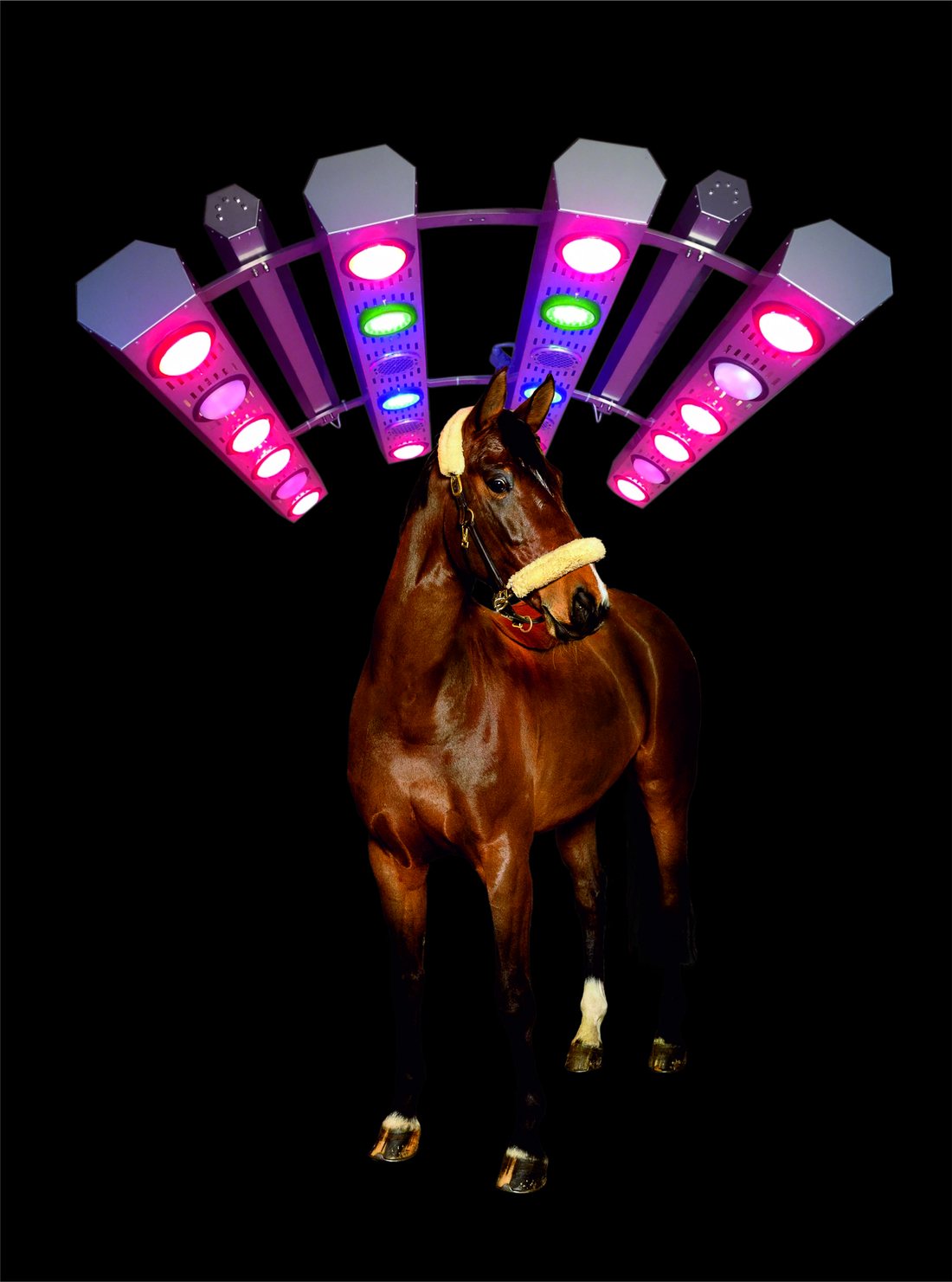
Horse solaria and light therapy

Kon pod solarium Summerwind Premium z terapia swiatlem kolorowym LED - obudowa z GFK i wlokna weglowego

Why it is worth using a horse solarium and light therapy

Solarium — Horse solaria and light therapy

Benefits of using a horse solarium

A solarium for sport horses is a system of several red lamps that emit infrared rays and produce short waves of infrared heat of the same kind as the sun. The heat of the infrared beam passes through the horse’s muscles and increases blood circulation and muscle elasticity (Mahlstedt, 2004), thereby speeding up healing after injury.
Using a solarium as an additional warm-up
before training supports the muscles of the horse’s back, making them more elastic and also relaxing them (Mahlstedt, 2004).
A solarium is also used to dry the horse after training or after a bath, especially in the colder part of the year. Using a solarium is also recommended after intensive training in order to relax tired muscles and reduce the risk of muscle soreness in the horse.
Heat generates a form of energy that increases metabolic activity in the cells, thereby improving blood circulation and causing ‘dilation of the capillaries’. This process increases blood flow through the body and delivers oxygen and nutrients to the cells. Increased circulation improves the condition and elasticity of the muscles, which can be seen to improve the horse’s suppleness and performance, and also helps to reduce the risk of injury and speed up recovery in injured horses.
By reducing tension and stress, a solarium has a positive effect on the nervous and immune systems. In addition it provides vitamin D — essential for the absorption of the minerals calcium and phosphate. This absorption helps to build and maintain healthy, strong bones.

Solarium sommerwind black — Horse solaria and light therapy

How a horse solarium works

Infrared radiation or infrared light (Latin infra = ‘below’; abbreviated IR) covers electromagnetic radiation with wavelengths longer than that of visible red light and shorter than that of radio waves. Infrared light is used in human and veterinary medicine and in physiotherapy. Infrared light is light from the part of the spectrum invisible to the human eye that lies below red light, i.e. 700 nm to 2000 nm. Red light has a wavelength of 660 nm and penetrates tissue to a depth of about 8–10 mm (Mahlstedt, 2004). As a result this light is very helpful in treating problems in shallower areas of tissue, such as wounds, cuts, scars and acupuncture points, and in particular is very effective in treating infections. Infrared light penetrates to a depth of about 30–40 mm, which helps in the healing of deeper tissues such as bones, joints and deep muscles (Mahlstedt, 2004). Different types of cells and tissues in the body have different light-absorption properties (specific wavelengths).
Solarium kucyk — Horse solaria and light therapy
Infrared radiation or infrared light (Latin infra = ‘below’; abbreviated IR) covers electromagnetic radiation with wavelengths longer than that of visible red light and shorter than that of radio waves. Infrared light is used in human and veterinary medicine and in physiotherapy. Infrared light is light from the part of the spectrum invisible to the human eye that lies below red light, i.e. 700 nm to 2000 nm. Red light has a wavelength of 660 nm and penetrates tissue to a depth of about 8–10 mm (Mahlstedt, 2004). As a result this light is very helpful in treating problems in shallower areas of tissue, such as wounds, cuts, scars and acupuncture points, and in particular is very effective in treating infections. Infrared light penetrates to a depth of about 30–40 mm, which helps in the healing of deeper tissues such as bones, joints and deep muscles (Mahlstedt, 2004). Different types of cells and tissues in the body have different light-absorption properties (specific wavelengths). For example, layers of skin, because of blood and their high water content, quickly absorb red light, while tissues made up of calcium and phosphorus are able to absorb light of other wavelengths. The red and infrared parts of the spectrum have a unique therapeutic effect on living organisms. Studies have shown that there are no side effects from this form of therapy, although in chronic conditions there may sometimes be an increase in pain or discomfort for a short time afterwards, which is a normal part of the healing and recovery process (Mahlstedt, 2004). Biologists have found that cells exposed to infrared light (light-emitting diodes) grow 150 to 200% faster than cells that are not exposed to stimulation by this type of light (Braukus and Berg, 2003). Infrared light most effectively stimulates blood flow to the target areas, that is, soft tissues such as muscles and blood vessels, but does not penetrate bone equally well. Even so, the stimulation produced by better blood flow speeds up bone regeneration (Koll, 2010).
The depth and effectiveness of wave penetration depend on the density of the skin, which is why therapy for horses has to be more intensive than for humans. Light-emitting diodes (LEDs) act similarly to a laser, because they have the same healing effects, but differ in the way light energy is delivered. The lamps used for light therapy operate at two specific wavelengths, which are the subject of ongoing research showing how dramatically light therapy increases the rate of healing.

Infrared pads

There is a modern form of infrared therapy emitted from pads (usually placed in rugs) which act locally. The advantages of this therapy are better circulation and the formation of new capillaries, reduction of swelling, pain relief, muscle relaxation, stimulation of collagen production,
increased DNA and RNA synthesis, stimulation of acupuncture points, etc. (Mahlstedt, 2004).
The ‘pads’ are designed in various sizes and can be used on the whole body of the horse, as they are safe, effective and inexpensive, and also easy to use on horses and dogs. The therapy time is about 10 minutes.
Rugs with an infrared system are very expensive; a cheaper alternative is ordinary single infrared pads, which unfortunately act only locally.

245456978 2040740729425280 6192311424590900148 n — Horse solaria and light therapy

Laser therapy

There are 2 types of laser, hot and cold: a) Hot lasers are used in surgery to remove unhealthy tissue without damaging the healthy tissue surrounding the damaged area. Hot lasers also seal the cut, so that there is no bleeding during procedures. b) Cold lasers have lower power and are used for therapeutic purposes. The therapy is often referred to as light therapy and is increasingly used to treat horses of all ages (Kaberline, 2010). It is believed that the energy produced by cold-laser therapy is absorbed by enzymes in diseased cells. The cells then show increased protein synthesis, activity in the cell nucleus and activation of cellular enzymes. This leads to increased production of collagen (Abergel et al., 1987) and epithelium, as well as relief of pain, inflammation and ligament injuries (McKibbin and Paraschak, 1984). Lasers have been found to stimulate wound healing, increase gene and collagen expression in the skin and facilitate wound healing in animals. Baxter et al. (1991) concluded that lasers can be used in the treatment of joint inflammation and burns. Lasers can be used to reduce pain and inflammation and to stimulate faster metabolism and faster healing of fractures (Trelles and Mayayo, 1987).

The use of infrared in horse breeding

Infrared thermography is widely used in veterinary medicine. In horse breeding, thermal imaging is used for the early detection of abnormalities in certain tissues even before the first visible symptoms appear.
245195367 1543571329327685 7725456661065347761 n — Horse solaria and light therapy

Infrared thermography for horses

Infrared thermography is a fast, painless, safe and non-invasive diagnostic method, with no harmful radiation. At the site of an injury the metabolism speeds up, resulting in a rise in body temperature. The thermograph records the temperature of the body (skin, muscles, tendons, joints and hoof), detecting areas of differing temperature. The positive side of this method is the early detection of potential problems and injuries (before the first visible symptoms, such as pain, swelling or lameness), which allows early prevention and ultimately results in considerable savings for breeders and owners (Lelak, 2011). X-rays are not useful in diagnosing soft tissue. Infrared light can indicate problems with tissues and can serve as an anatomical indicator of the cause of symptoms. Thermal checking of the horse’s back working under saddles can reveal unevenness and pressure leading to great discomfort for horse and rider. A complete infrared scan of a horse takes 20–30 minutes (Lelak, 2011). The scan is carried out where the owner and horse are based, to avoid the stress that can occur during transport. An infrared camera detects pain and any inflammation, strains and damage to tendons and ligaments, joint inflammation and even toothache (Mahlstedt, 2004).

Roewer & Rueb solaria

242221877 6157202501017745 177758647424708979 n — Horse solaria and light therapy

We recommend solaria from Roewer & Rueb — excellent units for everyday use and for light treatment.

The De Luxe solarium model has both UV and IR rays with an integrated air circulation system. As a result it has a very wide range of benefits, including all those described above. 


This post is based on the scientific paper

,,LIGHT AND ITS PRACTICAL APPLICATION THROUGH CHROMOTHERAPY ON SPORT HORSES”

UDK 636.046.5→798 Stručni rad Professional paper (237) STOČARSTVO 65:2011 (3) 237-246 SVJETLOST I NJENA PRAKTIČNA PRIMJENA POMOĆU KROMOTERAPIJE U ŠPORTSKIH KONJA Mirjana Baban, Marijeta Dežo, Elena Ćosić, Maja Sakač

Horse solaria and light therapy
Scroll to top