


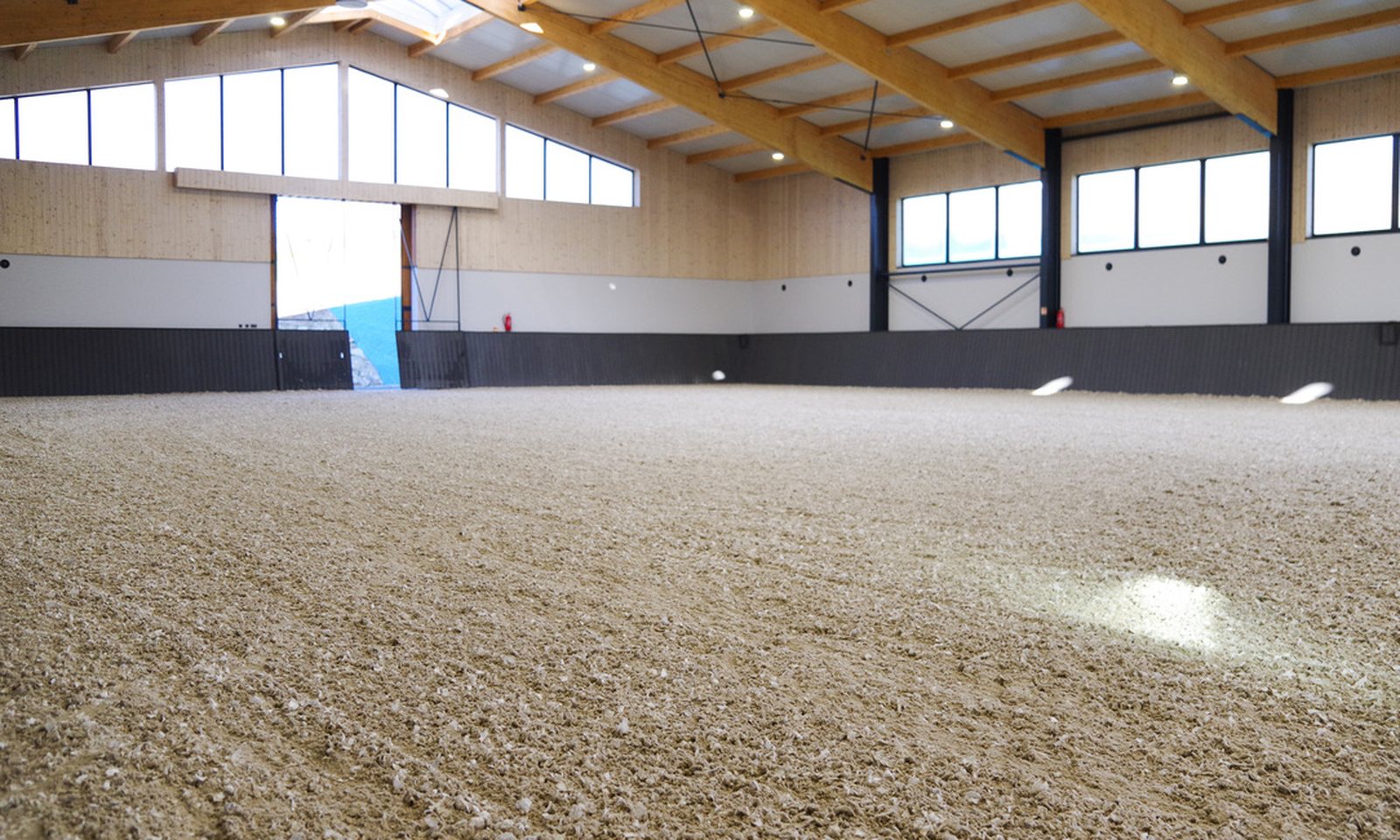
4Horses Consulting — advising clients on the design and equipping of equestrian centres since 2012. Hundreds of completed yards.
A surface is chosen once and worked on for fifteen years or so. The decision looks like a choice of material, but is really a choice of how the horse will move every day. In 2014 the International Equestrian Federation gathered the results of research on surfaces in a single document — the Equine Surfaces White Paper. Below is what follows from it for someone who is just planning an indoor or outdoor arena.
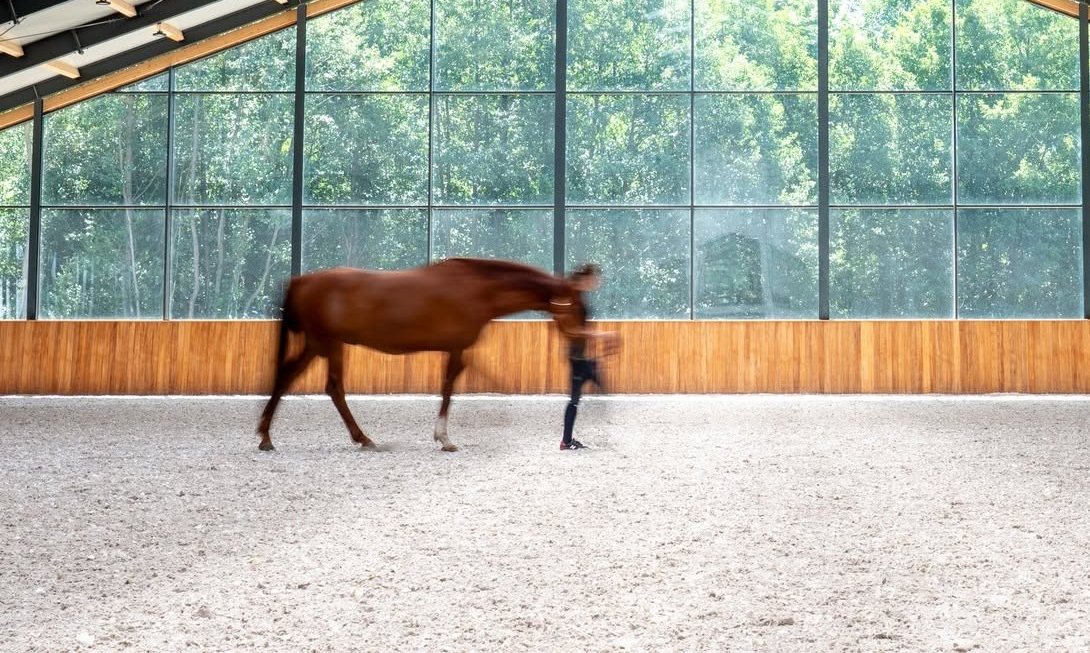
One stride of the horse is five phases of movement
The contact of the hoof with the surface looks like one fluid movement, but consists of five phases — and the surface does something different in each of them.
Before contact the horse speeds up the retraction of the leg to reduce the speed of the hoof relative to the ground. It is preparing for an impact that has not yet happened.
Primary impact is a large deceleration at surprisingly small forces — only the mass of the hoof and pastern takes part in this collision, not that of the whole horse. This is the phase most sensitive to the hardness of the top layer.
Secondary impact works in exactly the opposite way: the forces are large, the deceleration minimal. This is the moment when the mass of the horse catches up with the leg already planted on the ground.
The support phase is the peak of vertical load and the moment when the horse stops braking and starts to propel itself.
Breakover — the heel leaves the ground, the hoof rolls over the toe and the forces fall to zero. It is the resistance of the surface that determines how much material flies out from under the hoof.
An interesting point: the two impact phases have opposite characteristics, so a single layer has to reconcile two contradictory tasks — receiving the hoof softly and supporting the horse firmly.
What happens inside the hoof
Everything described above takes place above one joint that cannot be seen from the outside. The coffin joint lies entirely within the hoof capsule and connects the short pastern bone with the coffin bone. Just behind it sits the navicular bone, over which passes the deep digital flexor tendon, which ends on the underside of the coffin bone.
When the hoof takes the horse’s weight, the joint extends, the tendon tightens and presses on the navicular bone, and the hoof capsule spreads slightly at the heels. Once the load is removed everything returns to its place. This cycle is repeated with every stride, several thousand times in the course of one training session.
The surface determines how sharply this mechanism is loaded. On a surface that is too hard, the shock is taken by the bones and joints — including the coffin joint and the navicular bone. On one that is too deep, the work is taken over by the tendons and ligaments, because the horse has to push itself out of the layer. Between the two there is a narrow band in which the limb works as it should — and that is precisely what a surface is selected for.
The hoof must be allowed to slide
This is the most surprising conclusion from the FEI research. A good surface is not one that holds the hoof in place. A small amount of slide on landing is necessary for the horse, because it lowers the forces during deceleration.
When there is too little slide, the horizontal component of the force acting on the leg increases, and at higher speeds that means greater bending moments on the cannon bone. When there is too much slide, the digital flexor muscles receive a sudden, unforeseen load.
The surface is therefore to let the hoof travel a little way and stop it exactly when needed. How far the hoof travels is affected not only by the material itself, but also by the speed of the horse, the type of shoeing and the depth to which the hoof sinks in. That is why the same arena can behave differently in June and in November — the moisture changes, and with it the friction.
Five properties the FEI uses to describe a surface
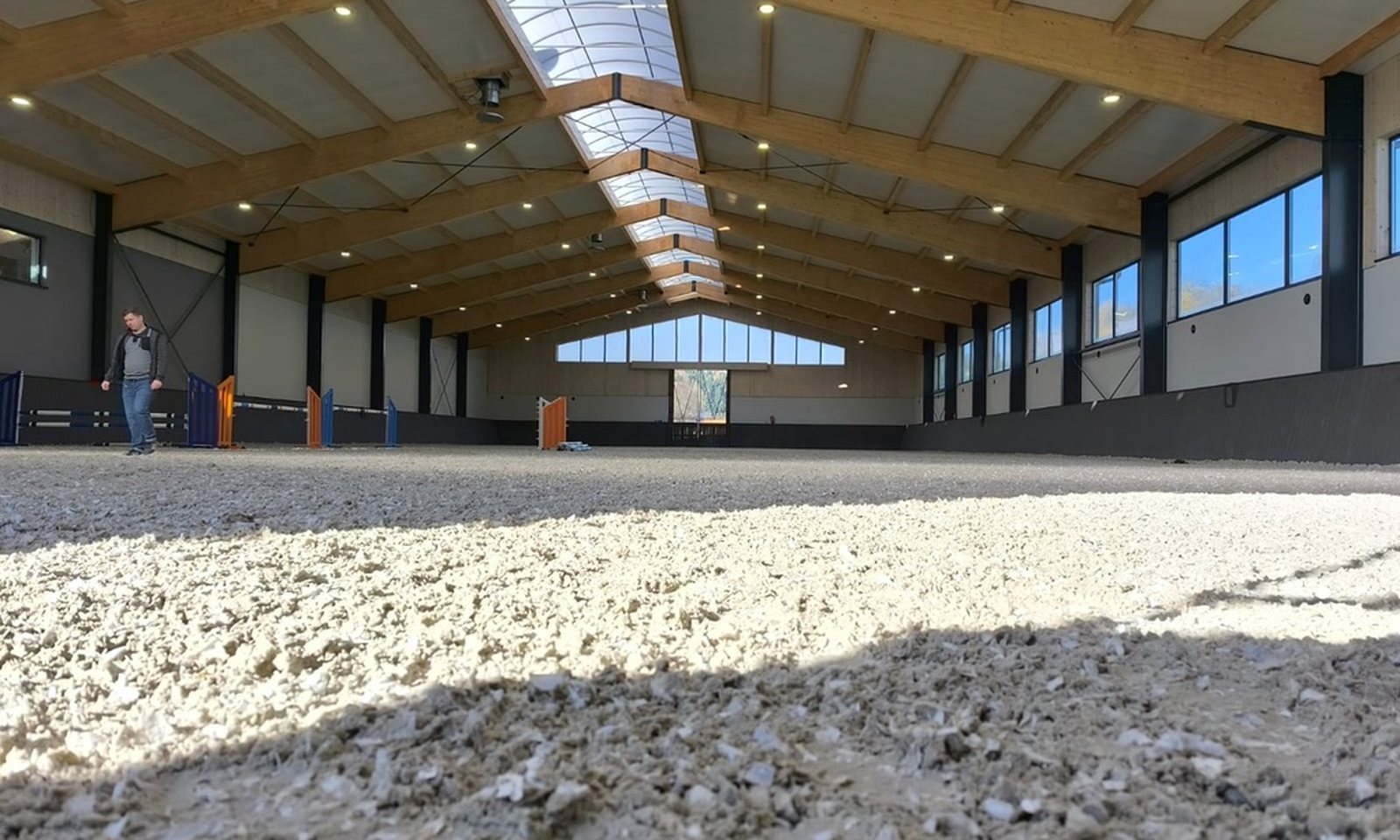
The white paper uses five terms. They are worth knowing, because they bring order to the whole conversation about surfaces.
Impact firmness — the shock the horse receives at the moment the hoof meets the ground. The higher it is, the more high-frequency vibration travels through the bones and joints of the lower leg. An interesting point: research cited by the FEI shows that just a few centimetres of sand on a hard layer markedly reduces this shock, although it does not change the load-bearing capacity of the whole build-up. The riding layer and the sub-base are therefore responsible for two completely different things.
Cushioning — how much force the layers absorb in the support phase. It is measured as the percentage by which the surface reduces the peak force compared with concrete.
Responsiveness — how quickly the surface returns to its original shape and gives back energy. If it returns it too quickly, it adds forces that the horse’s leg has to dissipate. If too slowly, the horse adds its own energy to push off.
Grip — how much the hoof slides on landing, in a turn and at push-off. It comes from a combination of the mechanical interlocking of the grains and the adhesion between them.
Uniformity — and this is the property spoken of least, yet it decides the most. The FEI requires it to be checked in two dimensions: across the whole area of the arena and over time. In one study a synthetic surface measurably hardened during the competition itself — horses competing on the first and the last day worked on a different surface. A horse that feels the same thing under its hooves in every place and on every day moves more confidently and is more willing to use the full length of its stride. Uniformity is the only one of the five properties that is not bought once at delivery — it is maintained with the leveller and water.
Water: between 8 and 17 per cent
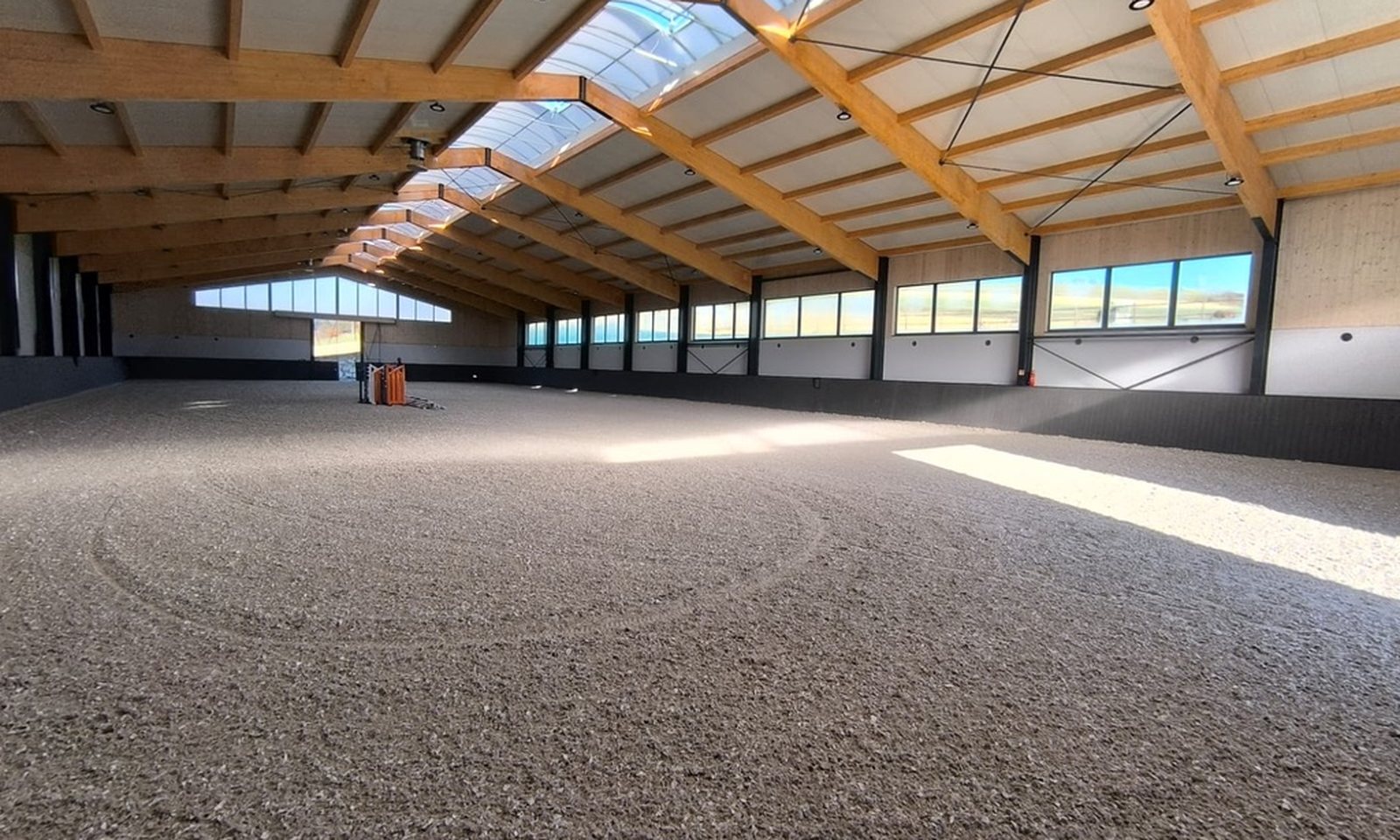
The white paper calls moisture the most important measurable physical property of a surface. Not the material, not the depth of the layer — water. The reason is simple: the shear strength of sand, which is what gives the horse purchase at push-off, reaches its maximum at a water content of between 8 and 17 per cent.
Below this range the grains do not hold together. The surface becomes loose, the hoof punches through the layer, grip falls and dust appears as well. Above saturation the strength falls again — excess water separates the grains instead of binding them, and the surface starts to shift under the hoof.
A practical conclusion follows from this, one that surprises many clients: irrigation does not mean watering when it gets dry. It means keeping the surface within a narrow moisture range for the whole time it is in use. The same task looks completely different indoors and outdoors — on an open arena rain and sun shift the moisture both ways every day, while indoors every drop has to be supplied by you.
The second point is evenness of watering. Moisture feeds directly into the uniformity the FEI speaks of: if one end of the arena is wet and the other dried out, the horse works on two different surfaces within a single lap. That is why, when assessing a method of irrigation, what counts is not only capacity but also whether the water reaches everywhere equally.
There are several ways of irrigating an arena — from sprinkling from above, through overhead systems, to sub-surface irrigation, in which water is delivered from below. Each performs differently in terms of water consumption, evenness and whether you can ride during watering. We will compare them in a separate article.
Why put a perforated mat under the surface
A perforated mat is a layer 4–5 cm thick laid on the prepared sub-base, beneath the riding layer. It does three things at once.
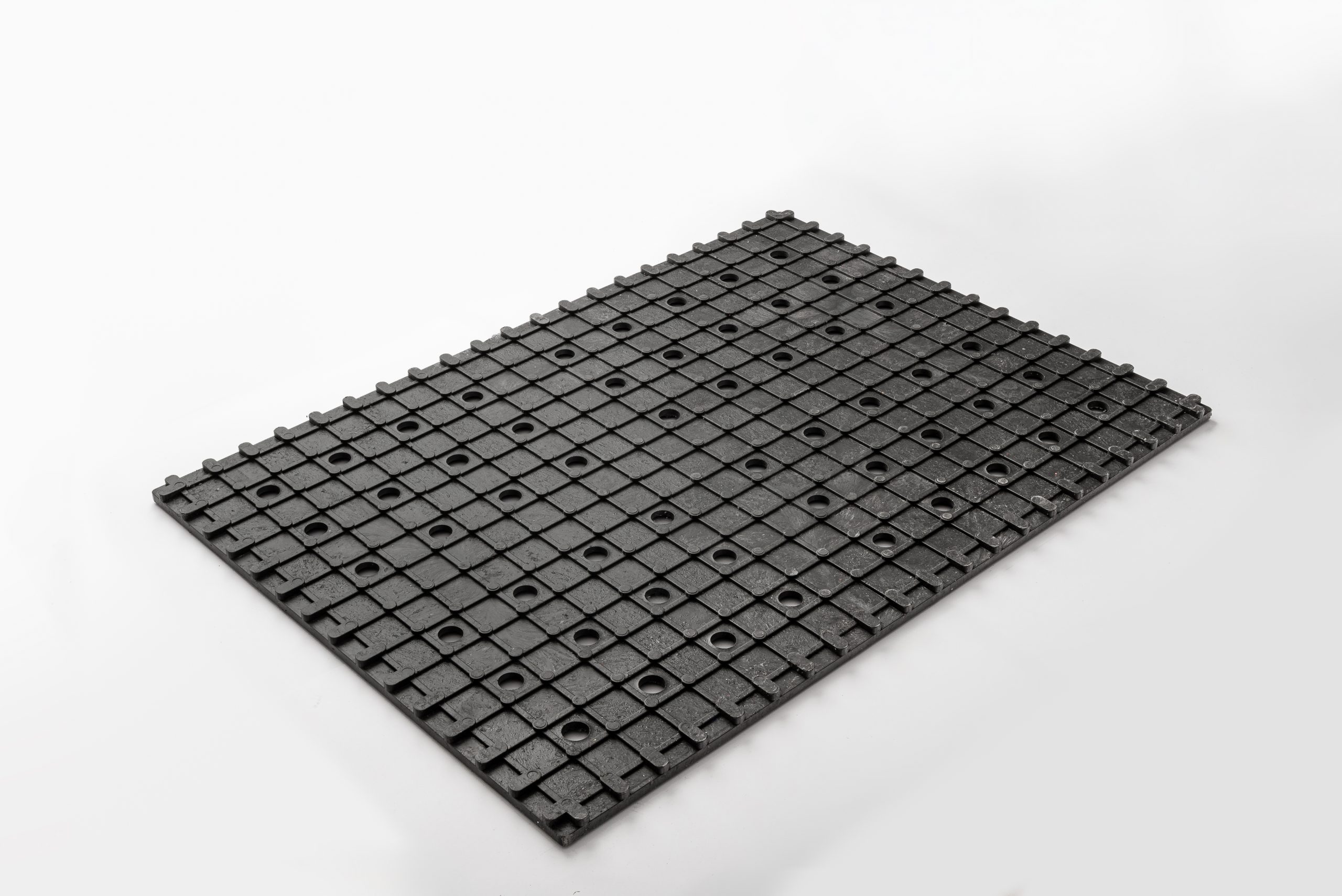
It keeps the depth of the surface constant. The quartz sand does not mix with the sub-base and does not wear into ruts along the kickboard. This translates directly into the uniformity the FEI speaks of.
It gives predictable support. Beneath a layer that is meant to work softly there is a firm, level reference — the same in every part of the arena.
It reduces the amount of material by a third. On a mat the riding layer consists of 8–10 cm of quartz sand with geotextile fibre. The same technology without a mat needs 15 cm — that is, half as much material again to buy, to spread and later to level.
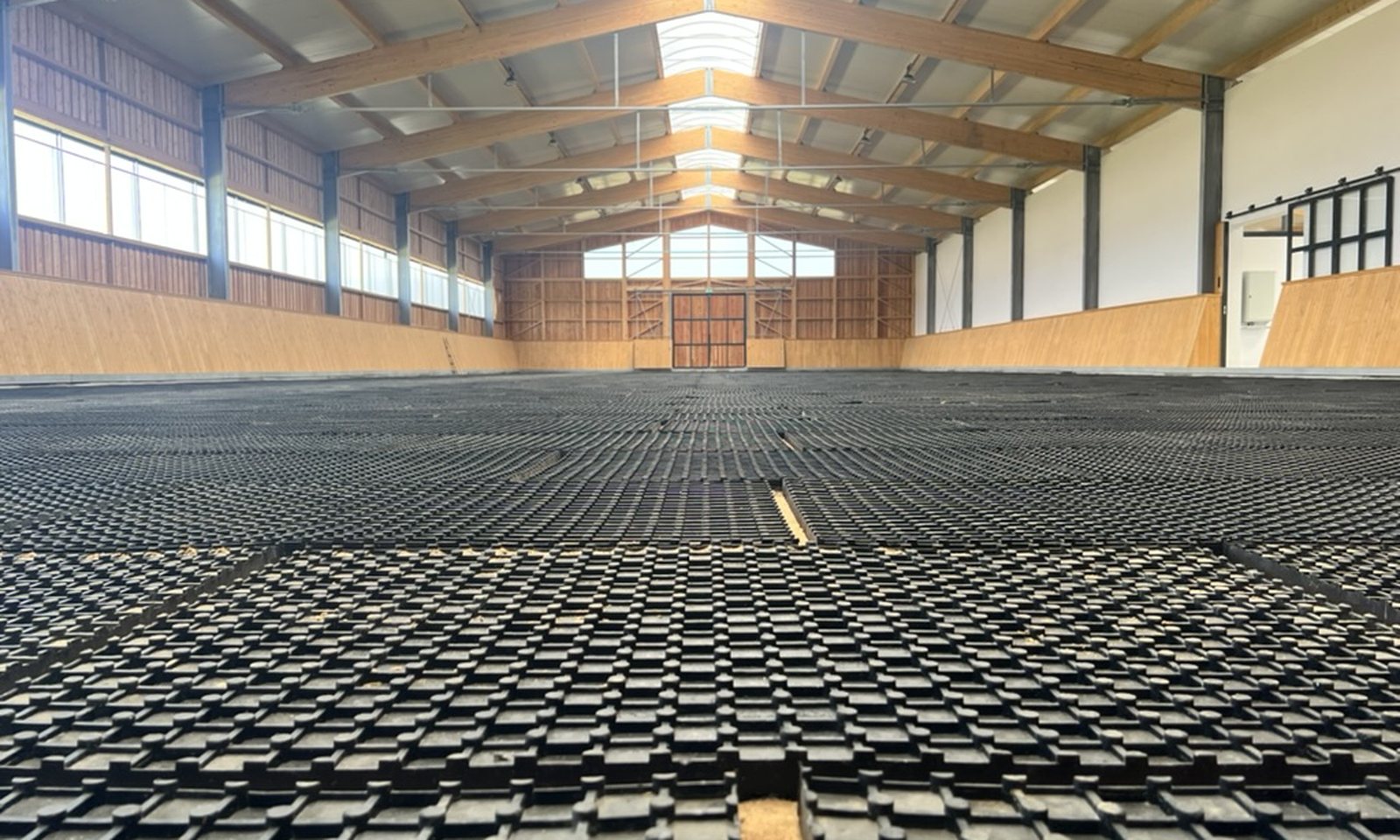
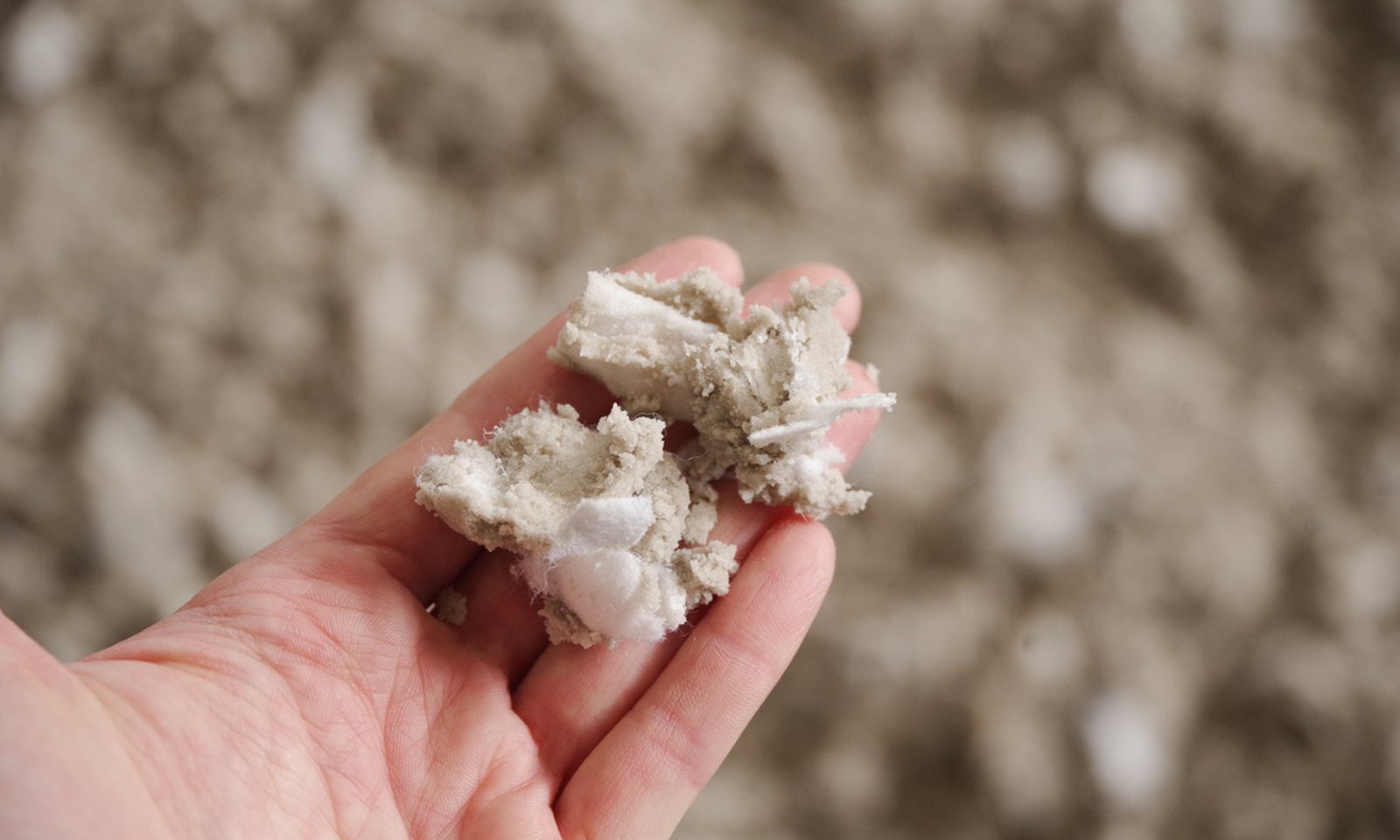
The perforations drain water downwards, into a 7 cm thick drainage layer of the 6–18 mm fraction. We dose the geotextile fibre at 2.5 kg/m² and always mixed with sand — it is what binds the quartz sand so that it does not escape from under the hoof.
What shapes the budget
No figures — the factors that really move the quote:
- Arena area — typically 800–1,500 m².
- Condition of the existing sub-base — whether we start from native ground or from a finished load-bearing layer.
- Chosen system — the amount of material per m² and whether mats and a water installation are added.
- Scope of delivery — material alone or material together with irrigation.
- Transport distance — surface material travels by the tonne, so the kilometres show in the quote.
In conclusion
Once you know which discipline, how many hours a day and who will maintain the arena, the choice narrows to one system. The rest you can work out in a few minutes: Get a surface quote online. Instructions for building the sub-base — for indoor and outdoor arenas — can be downloaded from the Arena surfaces page.
We advise, design and supply stable equipment. Since 2012.
Source of biomechanical data: Hobbs S.J., Northrop A., Mahaffey C., Martin J., Clayton H., Murray R., Roepstorff L., Peterson M., Equine Surfaces White Paper, Fédération Equestre Internationale, 2014 (CC BY 3.0 licence).
